Campaign strategy / US benefits technology
Four ads, one message
I find the thing a category refuses to say, then write against it.
Here that category is US benefits navigation software. Every company in it advertises clarity. I opened the LinkedIn ad library, read what Nayya and Rightway are actually running, and wrote four directions that say something else.
No client and no brief. I picked a category I had never worked in on purpose, because a method that needs inside knowledge is not a method.
Three buyers. The category talks to one.
Benefits navigation software sits on top of the health plans a US employer already offers and helps employees choose and use them. Three people decide whether it gets bought.
HR
Runs the selection and lives through open enrollment.
Finance
Signs off on the cost and never sees an ad.
Brokers
Decide which vendors get in the room at all.
Here is what they are all saying
Nayya and Rightway, live on LinkedIn, reviewed September 2026.
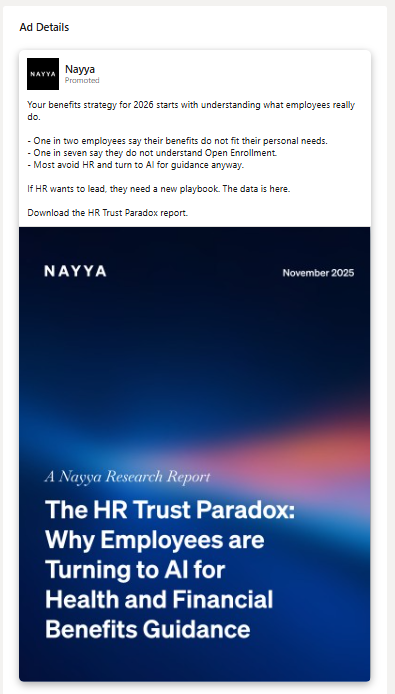
A serious research report, and it never says what any of it costs.
Nayya
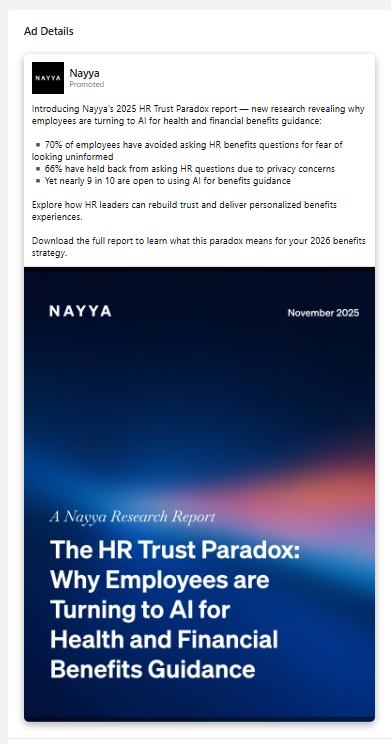
Same opening paragraph, different page underneath. That tests images, not ideas.
Nayya
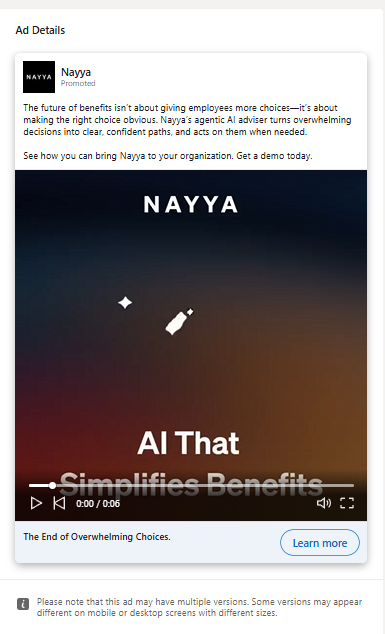
AI that simplifies benefits. So does everyone else's.
Nayya

Hexagons, a DNA strand, and an acronym the reader has to already know.
Rightway
Four marketers did not make the same mistake. A category agreed on its own language and stopped hearing it.
This is your employee in November.
So I go looking for what nobody will say
Three steps. They work the same way whether I know the category or not.
- Find what the category avoids. Usually a cost, or something the buyer already knows and no vendor will name out loud.
- Write the line that says it. Aimed at one buyer, including the ones nobody in the category is addressing.
- Decide what would prove me wrong. Before the budget goes live, not after the report.
Four directions worth testing
One argument each, aimed at a named buyer, with a defined way to fail. These are arguments, not finished ads.
HR / the cost of confusion
Your people did not choose the wrong plan. They chose the one they understood.
The category sells clarity, which is an outcome nobody argues with and nobody acts on. This refuses the outcome and names the loss instead.
Proves or disproves: whether a loss frame outperforms the category's standard clarity frame, with the same audience and the same offer.
HR / the locked calendar
You cannot change the plans. You can still change the outcome.
By the time enrollment opens, plan design is finished and the buyer knows it. Most ads in that window still ask them to reconsider a decision they cannot reopen.
Proves or disproves: whether accepting the buyer's constraint beats asking them to undo it.
Finance / the invisible line
You are already paying for care nobody needed.
Finance is a real buyer here and almost nobody advertises to them. They do not buy employee experience. They buy a number that stops going up.
Proves or disproves: whether waste framed as spend opens a second buying centre worth funding separately.
Brokers / the channel
Your client will not remember the rates you negotiated. They will remember whether their people could use what you sold them.
A broker is not a customer, it is a channel. One relationship is access to dozens of employers, and what is at risk is their book, not their client's experience.
Proves or disproves: whether brokers respond to their own retention risk more than to their client's outcome.
Sounding like your category is a fixable problem
I read the category first, find what nobody is willing to say, write against it, and decide up front what result would tell me I was wrong.
The metric is what a qualified lead costs, not what a lead costs.